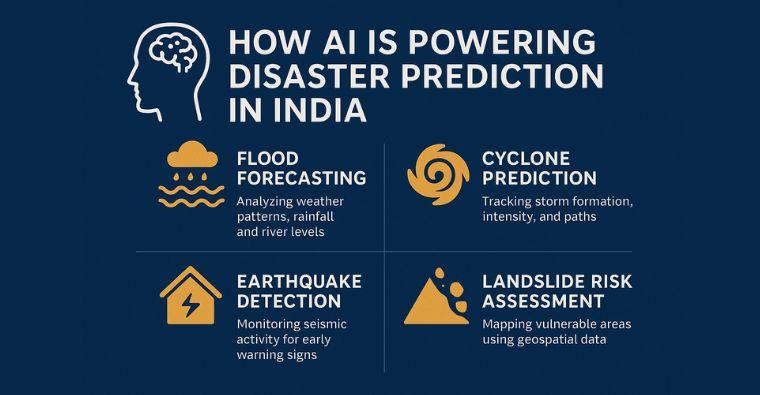
India’s Fight Against Natural Disasters
India faces frequent natural disasters—cyclones, floods, droughts, and earthquakes affect millions each year. Traditional methods of forecasting, while effective, often lack precision and real-time updates.
This is where Artificial Intelligence (AI) is stepping in. By analyzing massive datasets quickly and accurately, AI is revolutionizing disaster prediction, enabling faster responses and potentially saving thousands of lives.
1. Why AI Matters in Disaster Management
AI thrives on data—satellite imagery, historical records, sensor data, and climate models. It can:
- Detect patterns humans may miss
- Predict disaster likelihoods earlier
- Issue hyperlocal alerts
- Automate emergency workflows
In a country as vast and diverse as India, this means smarter and faster decisions in times of crisis.
2. Real-World Examples in India
✅ a. Flood Forecasting in Assam and Bihar
AI-powered models developed by Google in partnership with the Central Water Commission are being used to forecast floods in vulnerable regions like Assam and Bihar. These systems provide:
- Location-specific flood alerts via SMS and Google Maps
- Predictions up to 3 days in advance
- Accuracy that improves with every flood season
Millions have benefited from early warnings, allowing timely evacuations and minimizing damage.
✅ b. Cyclone Path Prediction
India’s coastal regions are frequently struck by cyclones. AI models now assist the India Meteorological Department (IMD) by:
- Tracking wind patterns, sea surface temperatures, and humidity
- Predicting cyclone intensities and landfall with better precision
- Supporting disaster planning and relief operations in states like Odisha and Andhra Pradesh
✅ c. Earthquake and Landslide Monitoring
While earthquake prediction remains complex, AI is used to analyze seismic data to improve early detection and post-disaster damage estimation.
In the Himalayan belt, AI helps map landslide-prone zones by using satellite data and rainfall models—enabling preemptive relocation or mitigation.
3. AI-Powered Tools and Startups in India
Several Indian startups and government collaborations are leveraging AI:
- SatSure: Uses satellite data and AI for crop damage and flood risk analysis.
- Gramener: Works on data-driven disaster dashboards for quick action.
- Predictive Analytics by ISRO: Helps forecast droughts and monsoon behavior using machine learning.
4. Government Support and the NDMA’s Role
The National Disaster Management Authority (NDMA) is working closely with tech partners to modernize India’s disaster response systems.
Key initiatives include:
- Open data portals for real-time information sharing
- AI-powered command centers for faster coordination
- Public-private tech collaborations for innovation
5. The Challenges Ahead
While AI holds promise, challenges remain:
- Data Gaps: Inconsistent or outdated data from remote regions
- Connectivity Issues: Especially in disaster-prone rural areas
- Public Awareness: People may ignore or misunderstand AI-generated alerts
- Ethical Use: Ensuring data privacy and equitable tech access
To overcome this, India needs infrastructure upgrades, training programs, and public outreach.
6. A Safer Future Powered by AI
AI cannot stop disasters—but it can reduce their impact. As the climate crisis worsens, India’s investment in AI-based disaster prediction is not a luxury but a necessity.
With the right partnerships, policies, and public education, India can build a more resilient future—one where technology and humanity work together to protect lives.Intelligence That Saves Lives
Artificial Intelligence is not just about automation or data—it’s about insightful action when every second counts. From floods to cyclones, AI is giving India the tools to predict, prepare, and protect.
As these technologies evolve, India stands to become a global model for AI-led disaster resilience.