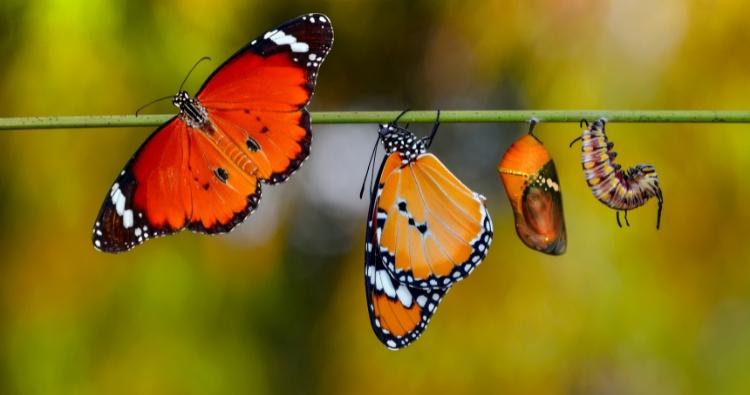
From a tiny egg to a majestic monarch, the journey of a butterfly is divided into four distinct stages: egg, larva (caterpillar), pupa (chrysalis), and adult butterfly. Each stage is crucial for the development and metamorphosis of the butterfly.
Stage 1: Egg
The life cycle of a butterfly begins with the egg. Female butterflies lay their eggs on the leaves of host plants, which vary depending on the species. These eggs are usually very small, often no larger than a pinhead, and can be round, oval, or cylindrical. The eggs are laid singly or in clusters, and they adhere to the surface of the leaf.
The duration of the egg stage varies depending on the species and environmental conditions. Typically, it lasts from a few days to a couple of weeks. During this time, the egg's outer shell, known as the chorion, protects the developing larva inside.
Stage 2: Larva (Caterpillar)
Once the egg hatches, the larva, commonly known as a caterpillar, emerges. This is the primary growth stage for the butterfly, during which the caterpillar’s main job is to eat and grow. Caterpillars are voracious eaters, consuming large quantities of leaves to accumulate the energy needed for their transformation.
Caterpillars undergo a series of molts as they grow, shedding their skin multiple times. Each growth period between molts is called an instar. Depending on the species, caterpillars may go through five or six instars before they are ready to pupate.
During the larval stage, the caterpillar's body structure is simple. It has a segmented body with a distinct head, thorax, and abdomen, along with several pairs of legs and prolegs. As the caterpillar grows, it stores energy in the form of fats and nutrients, which will be crucial for its metamorphosis.
Stage 3: Pupa (Chrysalis)
When the caterpillar reaches its full size, it enters the pupal stage, forming a chrysalis. To begin this process, the caterpillar finds a suitable location and attaches itself to a support, such as a twig or leaf, using silk threads. It then sheds its final larval skin to reveal the chrysalis.
Inside the chrysalis, remarkable changes occur. This stage, known as metamorphosis, involves the breakdown of the caterpillar's tissues and the formation of the butterfly's adult structures. Specialized cells called imaginal discs, which were dormant in the larva, develop into the wings, legs, antennae, and other adult features.
The pupal stage can last from a few weeks to several months, depending on environmental factors and the butterfly species. During this time, the chrysalis may change color, becoming transparent as the adult butterfly nears emergence.
Stage 4: Adult Butterfly
Finally, the adult butterfly emerges from the chrysalis in a process called eclosion. The butterfly uses its legs to break open the chrysalis and slowly crawls out. At this point, its wings are small, crumpled, and wet. The butterfly pumps hemolymph (insect blood) into the wings to expand and strengthen them.
Once the wings are fully extended and dry, the butterfly is ready to take flight. The adult butterfly's primary goals are to feed on nectar, mate, and lay eggs to start the life cycle anew. Butterflies have a proboscis, a long, coiled tongue, which they use to sip nectar from flowers.
Adult butterflies are also responsible for pollination, playing a crucial role in the ecosystem. They are typically short-lived, with lifespans ranging from a few weeks to several months, depending on the species and environmental conditions.
Monarch Butterflies: A Special Case
Among butterflies, monarch butterflies are particularly famous for their long migratory journeys. Monarchs in North America undertake an incredible migration, traveling thousands of miles from Canada and the United States to central Mexico, where they overwinter. This journey spans multiple generations, with each generation continuing the migration southward or back northward.
Monarchs are also known for their specific host plant, milkweed, on which they lay their eggs and which serves as the sole food source for their caterpillars. The toxins present in milkweed make the monarch caterpillars and adult butterflies unpalatable to predators, providing them with a defense mechanism.